How Stevie Ray Vaughan Found His Sound
The Stevie Ray Vaughan Files, Vol. 2: The Sound
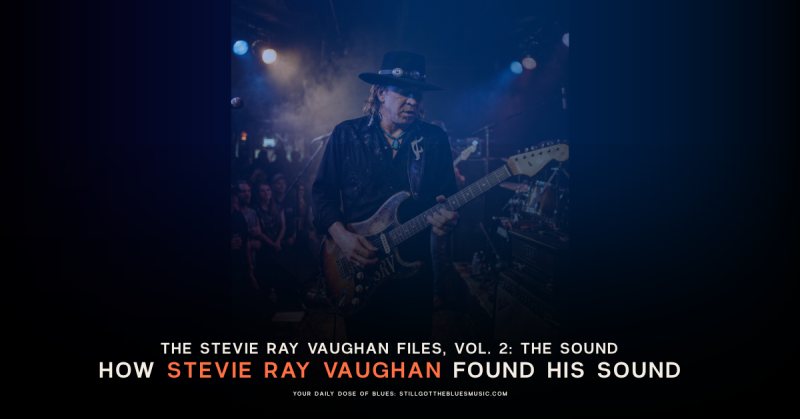
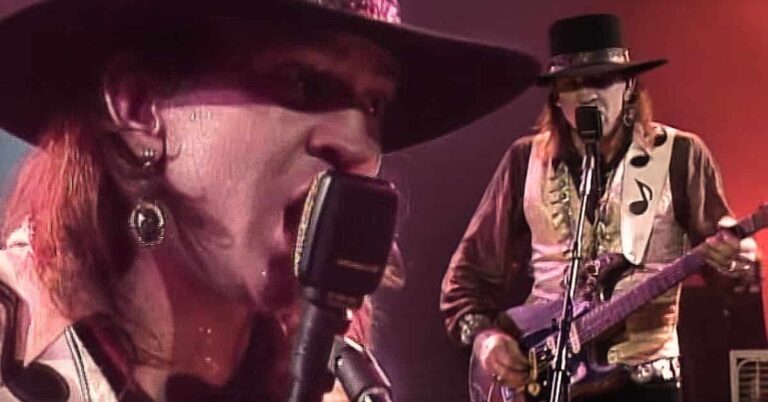
Stevie Ray Vaughan did not find his sound by copying one guitarist, buying one famous guitar, or following a single path. His style grew from years of listening, watching, practicing, and playing music that came from different corners of American blues, rock, and jazz. By the time the world heard him with Double Trouble in the early 1980s, the sound was immediately recognizable. But behind it stood a long line of musicians whose records had helped shape the way Stevie Ray Vaughan heard the guitar.
It began close to home.
Growing up in Dallas, Texas, Stevie was strongly influenced by his older brother, Jimmie Vaughan. Jimmie brought records into the house, and Stevie listened closely to the players who filled those recordings. Albert King, B.B. King, Freddie King, Albert Collins, Buddy Guy, Hubert Sumlin, and others became part of his musical education. Stevie did not simply hear the guitar as an instrument for playing solos. He heard it as a voice.
One of his earliest and most important influences was Lonnie Mack. Vaughan later recalled trying to copy licks from Mack’s records when he was young. Mack’s playing carried blues phrasing but pushed it with a harder attack and a rock-and-roll edge. That combination made a lasting impression. Stevie would eventually build a style that could move between traditional blues language and louder, more aggressive electric guitar without treating them as separate worlds.
Then there were the Kings.
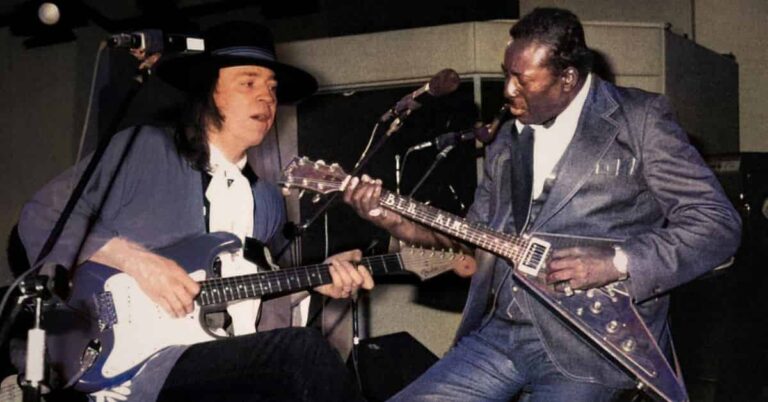
Albert King had a major effect on Vaughan’s phrasing. His wide bends, sharp vibrato, and ability to make a single note seem to speak became part of Stevie’s own musical vocabulary. B.B. King offered another lesson, showing how much could be said through space, phrasing, and control. Freddie King brought a tougher Texas attack, combining blues with an instrumental force that Stevie would also carry into his own playing.
Stevie also learned from Albert Collins, Otis Rush, Muddy Waters, Buddy Guy and other blues musicians whose work gave him different ways to approach rhythm, tone and phrasing. These were not influences that disappeared once he began playing rock music. They remained at the center of his sound.
But Stevie Ray Vaughan’s guitar world did not stop with the blues.
As a teenager, he became deeply interested in Jimi Hendrix. Hendrix showed him that the guitar could fill more than one role at a time. A player could move between chords, rhythm figures, feedback, single-note lines, and improvisation without stopping to separate them. That idea became one of the defining parts of Vaughan’s approach.
Listen to Stevie’s playing closely, and the influence can be heard not as simple imitation, but in the way he could combine rhythm and lead guitar within the same passage. He could strike a chord, answer it with a blues phrase, add another chord fragment, then move into a solo without breaking the musical flow. Hendrix helped open that door, but Stevie walked through it with his own Texas blues foundation underneath.
He also listened beyond blues and rock. Jazz guitarists such as Django Reinhardt, Kenny Burrell, and Wes Montgomery were among the players connected to Vaughan’s musical development. Stevie was interested in musicians who could make the guitar move freely and melodically. In a 1984 interview, he spoke about Django and Hendrix together, admiring the originality both brought to the instrument in very different musical settings.
All of these influences mattered, but influence alone does not create an individual sound.
That part came through playing.
By the time Vaughan had established himself in the Texas club circuit and later formed Double Trouble, his guitar style had become physically demanding and highly personal. He played with a strong right-hand attack. He bent strings hard and wide. He used heavy strings and often tuned his guitar down a half step, creating a different feel under his fingers while allowing him to push notes with the force he wanted.
His playing could be loud, but volume was not the same thing as distortion.
One of the most misunderstood parts of Stevie Ray Vaughan’s sound is the belief that it came mainly from an overdrive pedal. His tone was shaped by several pieces of equipment, including Fender Stratocasters, powerful tube amplifiers, and Ibanez Tube Screamer pedals, but the equipment worked as part of a larger system. The way he struck the strings, controlled his hands, and used the guitar’s volume and tone controls mattered just as much.
Vaughan often pushed his amplifiers hard enough to make them respond to his playing. A softer touch could produce a cleaner sound. A harder attack could push the sound further. This gave his guitar a wide range without requiring constant changes in equipment. The difference could come from the player himself.
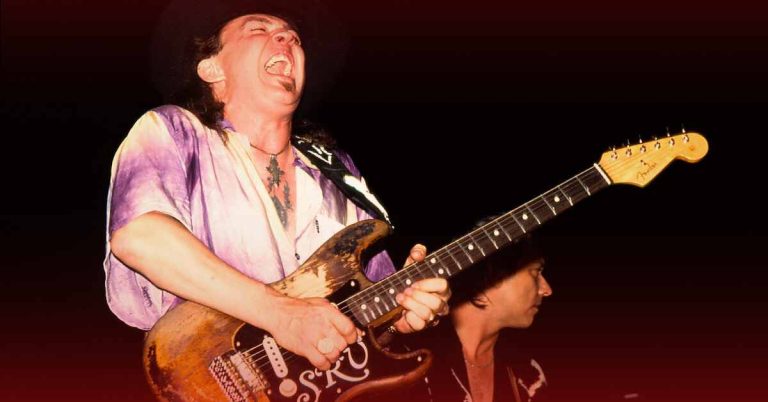
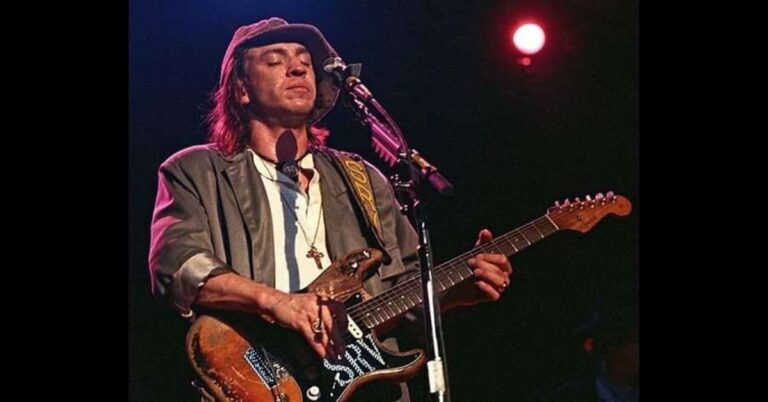
His best-known instrument became the battered Fender Stratocaster called Number One, which he acquired in Austin in the 1970s. The guitar changed over the years through repairs and modifications, but its connection with Vaughan became permanent. The Stratocaster’s bright single-coil sound gave him clarity, while his heavy attack and powerful amplifiers gave the notes weight.
That balance became a major part of his tone.
The sound could be sharp without becoming thin. It could be rough without losing definition. His rhythm playing had a strong percussive quality, while his single-note lines could stretch and bend with the vocal quality he had learned from the blues masters.
The Tube Screamer became one of the pieces associated with his sound, but it was not there simply to create large amounts of distortion. Used with already powerful amplifiers, it could push the signal and shape the midrange while allowing the basic character of the guitar and amplifier to remain present. His equipment changed at different times, and he used a variety of guitars, amplifiers, and effects, but the central principle remained the same: the sound began with his hands.
That was why copying Stevie Ray Vaughan became so difficult.
A guitarist could buy a Stratocaster, use heavy strings, tune down, connect a Tube Screamer, and turn up a Fender amplifier. The equipment might move closer to the sound, but the phrasing, attack, and control still belonged to Stevie.
His style was built from recognizable elements, yet the combination was his own.
Albert King’s bends were part of the language. Freddie King’s attack was part of the background. B.B. King taught the value of phrasing. Lonnie Mack helped point him toward a harder electric sound. Hendrix showed what could happen when rhythm and lead guitar were allowed to move together. Albert Collins, Otis Rush, Muddy Waters, and others added more voices to the musical conversation. Jazz players expanded the possibilities further.
And through years of playing, Stevie Ray Vaughan turned those lessons into something that no longer sounded like a collection of influences.
It sounded like him.
By the time Double Trouble began reaching a wider audience, Vaughan’s sound was already fully formed. The guitar could carry the weight of a blues band while also filling spaces normally shared by rhythm and lead players. His solos could be technically demanding, but they were rooted in blues phrasing. His tone could be fierce, but it remained connected to the players he had spent years studying.
That combination would soon carry him far beyond the Texas clubs where his style had developed.
The sound was ready. But there was still one moment that could change everything. The next chapter tells the story of the album that brought Stevie Ray Vaughan to a much wider audience and changed his career forever.